
Who's the Best for Calculate Cash Flow: DealCheck vs Tranchi
Most investors still toggle between two tabs to run cash flow numbers and hunt for deals. The split wastes time and leaves one side of the work half done.
By the end of this article you will see exactly how Tranchi AI and DealCheck differ in cash flow accuracy, automation depth, and total cost, then decide which platform matches your current deal volume and whether you are willing to keep sourcing properties outside the tool.
Quick Verdict: Tranchi AI vs DealCheck for Cash Flow Calculation
Tranchi AI delivers full-deal automation plus cash-flow math while DealCheck remains a manual-input spreadsheet.
The single decisive difference comes down to scope. Tranchi AI automates 95 % of underwriting and funding execution through 44 different AI agents. DealCheck stops at user-entered formulas that the investor must build and maintain.
Consider a typical property investment. Tranchi AI handles these calculations in the background.
The automation covers net operating income, cash-on-cash return, and internal rate of return. Users still review results, yet most of the data entry and formatting disappears. This advantage matters most for investors analyzing multiple properties each month.
DealCheck works if you prefer total control over every cell. Yet most users find the manual approach limits how many deals they can review. Tranchi AI removes that bottleneck while keeping the same core investment metrics.
At a glance: how Tranchi AI compares to DealCheck on the features that matter most.
| Feature | Tranchi AI | DealCheck |
|---|---|---|
| Calculate Cash Flow | ✓ | ✓ |
What Is Tranchi AI?

Tranchi AI is a SaaS platform of 44 specialized agents that scan hidden government databases, auction sites, and off-market listings.
The system finds profitable real estate deals without requiring AI experience from users. It handles 95 percent of the work and saves hundreds of hours of searching.
Four core agent clusters power the platform. They are the Off-Market Deal Scanner, AI Underwriting Engine, Automated Funding System, and Transaction Automation Layer.
Users typically invest one to two hours per day with the platform. This focused time replaces the lengthy manual processes common in traditional property investment.
The platform supports real estate analysis through automated underwriting and funding steps. These steps help calculate cash flow, net operating income, and other key investment metrics.
Tranchi AI reduces the need for manual property valuation, pro forma creation, and financial modeling. It streamlines the deal analysis workflow from acquisition costs to exit strategy.
What Is DealCheck?
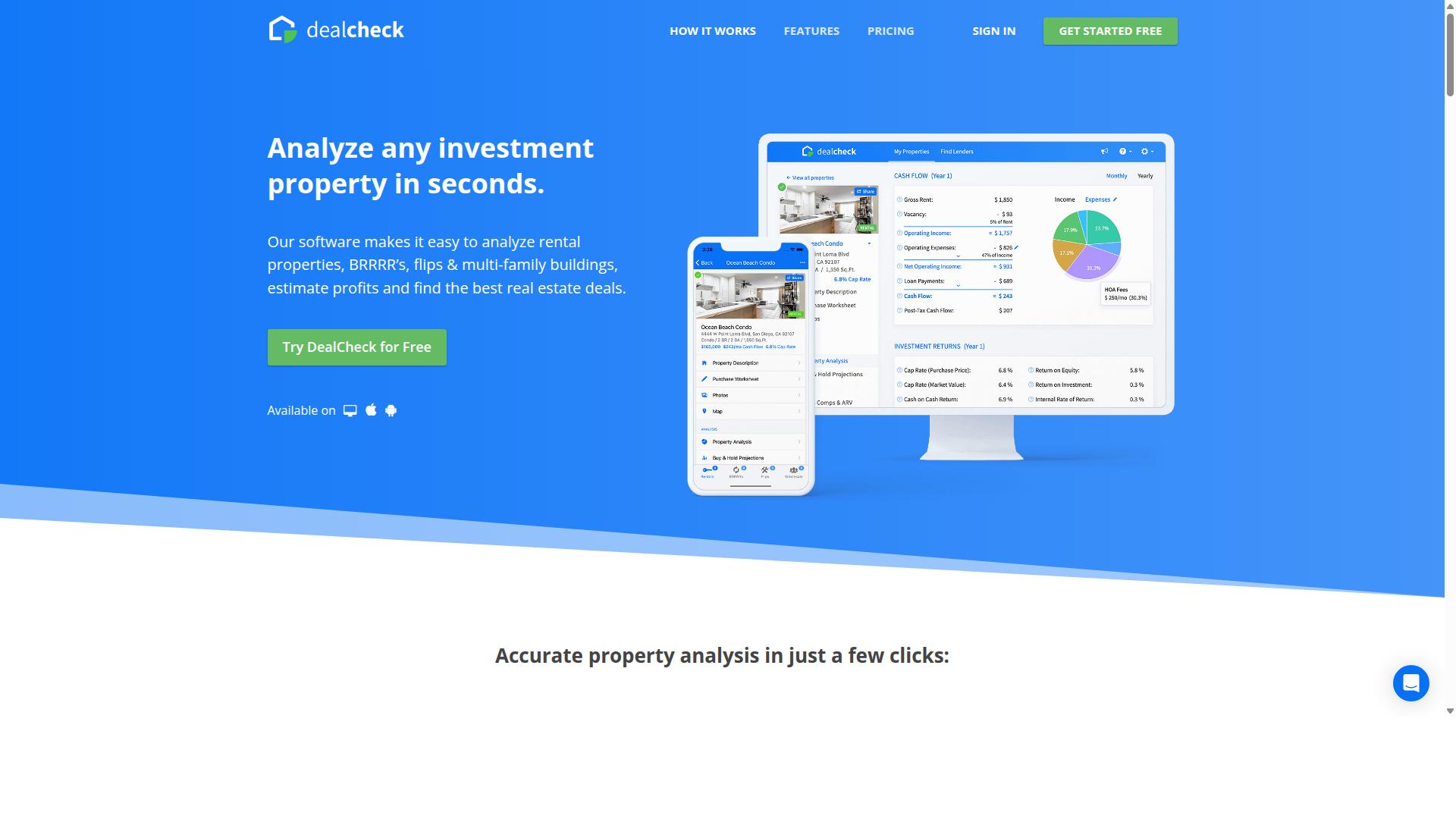
DealCheck is a web-based spreadsheet tool that lets investors manually input rents, expenses, and financing assumptions to generate cash-flow and return metrics. Users must enter each data point themselves, including rental income, operating expenses, and debt service details.
This approach can work for simple property investments where the data is already organized. It may also suit people who prefer to build their own models from scratch using known assumptions.
The manual nature of DealCheck means accuracy depends entirely on the quality of the inputs provided. Investors often spend significant time reconciling numbers across multiple worksheets before they achieve a reliable cash flow forecast.
Features Compared
Three functional areas separate the platforms: calculation depth, data sourcing, and post-analysis automation.
Understanding these differences helps investors choose tools that match their workflow and risk tolerance.
The comparison focuses on how each platform handles cash flow calculation, deal sourcing, and transaction support.
Cash Flow Calculation Accuracy
DealCheck relies entirely on user-entered numbers, while Tranchi AI pulls verified sale prices, tax records, and insurance quotes automatically.
The AI Underwriting Engine imports vacancy rates, property taxes, and debt service to eliminate manual entry errors.
This approach reduces mistakes that occur when investors transfer data between multiple sources.
Accurate inputs support reliable projections for rental income, operating expenses, and net operating income calculations.
Tranchi AI maintains consistency across cap rate, cash-on-cash return, and IRR metrics without requiring repeated data entry.
AI-Powered Deal Flow & Underwriting
Tranchi AI's 44 agents scan probate filings, MLS off-market feeds, and lien databases 24/7 to surface undervalued assets before they hit public portals.
The Off-Market Deal Scanner and AI Underwriting Engine work together to identify opportunities and generate financial models.
DealCheck requires investors to locate properties through separate channels before analysis begins.
Tranchi AI combines sourcing and underwriting in one automated process that includes All Deal Types & Unlimited Analysis.
Automation & Execution Support
After underwriting, Tranchi AI's Execution Agents auto-generate offer letters, coordinate title, and trigger funding through its Automated Funding System.
This hand-off covers Transaction Automation Layer functions from initial contact through closing.
DealCheck typically ends its role once calculations are complete, leaving investors to manage follow-up steps separately.
Tranchi AI includes Seller Outreach Automation, AI-Assisted Offer Negotiation, and Capital Stack Structuring within its workflow.
The platform also provides access to Hard Money Lenders, Private Lenders, and Cash Buyers Network through its vetted contacts system.
Pricing Compared
Tranchi AI lists its Operator plan as Contact Sales for pricing. This model works well for property investors who need custom crafted AI agent capabilities for their cash flow calculation needs.
The 90-day money-back guarantee gives users time to test the platform against their specific real estate analysis requirements. Users can cancel anytime if the service does not meet their deal analysis expectations.
Property investment decisions often involve complex financial modeling with multiple moving parts. The ability to reach out directly for pricing discussions allows the platform to tailor solutions to individual underwriting workflows.
DealCheck's pricing structure is not compared in this analysis. Investors evaluating cash flow calculation tools should review both platforms directly to understand current pricing models and feature differences.
The flexibility to cancel anytime reduces risk for property investors who need reliable cash flow forecasting tools. Custom AI agent development can address specific requirements around NOI calculations, cap rate analysis, and debt service modeling.
Who Should Choose Tranchi AI
Real estate newcomers, former 9-to-5 workers, and small business owners who want 95 percent of the workflow automated are the core Tranchi AI audience. These users often lack formal finance training yet need accurate cash flow calculation for their property investments. The platform serves people who invest one to two hours per day in their deals.
Beginner investors with no experience or money find the software especially helpful. They can run rental income projections, operating expenses, and net operating income without building spreadsheets from scratch. Small business owners who already manage multiple properties appreciate the streamlined approach to cap rate and cash on cash return metrics.
Former Uber drivers and other former 9-to-5 workers who now focus on property investment also fit this profile. They typically juggle family responsibilities alongside deal analysis and prefer tools that reduce manual data entry. Tranchi AI handles the core underwriting tasks so users can focus on property selection rather than formula construction.
Users who need consistent debt service calculations, mortgage payment schedules, and vacancy rate modeling benefit from the automated framework. The software supports insurance costs, property taxes, and property management fees within the same workflow. This reduces the risk of missing line items that affect final IRR and NPV figures.
Tranchi AI targets people who want to move quickly from acquisition costs through exit strategy without hiring external analysts. The one to two hour daily commitment matches the pace of most part time investors who review one or two deals per week. This audience values speed and simplicity over advanced customization options.
Who Should Choose DealCheck
DealCheck may suit investors comfortable building every assumption manually and who already have their own data sources. The platform appeals to users who prefer constructing their models from the ground up without relying on automated inputs or external data feeds.
Property investors who work with customized assumptions often find this approach fits their workflow. They can adjust rental income projections, operating expenses, and financing terms to match their specific deal parameters.
Some analysts value the flexibility to modify every line item in their pro forma. This control proves useful when evaluating unique property types or markets where standard assumptions may not apply.
The tool works well for those who maintain detailed records of debt service, property taxes, and insurance costs from their own research. Users can input these figures directly rather than pulling from integrated databases.
Manual cash flow calculation requires time to verify each component. Investors who already possess reliable data sources may prefer this method over platforms that attempt to automate the process.
Final Verdict
Tranchi AI wins for investors who want automated underwriting, off-market sourcing, and end-to-end execution in a single platform. DealCheck offers basic cash flow calculation tools that many users find sufficient for simple property analysis.
The 5.0 rated platform stands out because 44 agents work together to handle the complete investment workflow. This team approach reduces the manual steps that property investors typically face when switching between different software solutions.
Tranchi AI provides a 90 day guarantee that gives investors time to test the platform against their actual deal pipeline. This extended period allows users to verify that the automated calculations match their manual review processes.
Support options include email responses within 24 hours and live chat available Monday through Friday from 9am to 5pm EST. Investors can also schedule phone callbacks or submit requests through the support form with name, email, and phone number fields.
Real estate professionals evaluating DealCheck vs Tranchi should consider whether their workflow benefits from integrated deal sourcing combined with automated underwriting capabilities. The choice depends on the complexity of deals and the need for coordinated execution across multiple investment activities.